

Chatbots and AI companions have rapidly moved from science fiction into everyday life. Credit: Shutterstock
By Joseph Chamie
PORTLAND, USA, Jun 15 2026 – AI chatbots and AI companions designed to simulate human-like conversation and provide relationships and companionship through generative artificial intelligence (AI) have rapidly evolved from science fiction into everyday reality.
Globally, approximately one billion people – about 12% of the world’s population – now use generative AI chatbots monthly, with usage approaching parity among men and women.
Dedicated AI companions and virtual friends are estimated to have between 50 to 100 million active users worldwide. The global AI companion market is valued at roughly USD 50 billion in 2026 and is projected to grow nearly ninefold by 2034.
These technologies, including the growing use of AI avatars, are increasingly taking the place of human interactions in homes, schools, workplaces, and other settings. Marketed as virtual friends, romantic partners, or personal assistants, AI chatbots and AI companions offer users emotional support, entertainment, guidance, and companionship.
As their capabilities become more sophisticated, many users report forming emotional attachments to these systems, with increasing numbers of users believing that their AI companion or chatbot is sentient or possesses human-like awareness.
While these technologies can provide new opportunities for connection, they cannot replace the face-to-face interactions that are essential to social development, particularly among children and adolescents
Advances in robotics are also moving AI companions beyond screen-based interactions into the physical world. With increasingly human-like appearances, behaviors, and communication abilities, these systems are becoming more sophisticated and human-like in the way they interact with people.
Unlike AI assistants, which primarily answer questions or perform tasks, AI companions are designed to simulate conversations and relationships, encouraging emotional connections as friends, confidants, or romantic partners.
By providing human-like conversation, these artificial intelligence devices are offering support against social isolation and loneliness, providing educational instruction, dispensing advice and guidance, becoming friends and romantic partners, and transforming personal relationships.
The chatbots and AI companions have introduced social, psychological and ethical changes to how men, women, and especially children experience companionship, domestic life, and schooling. In particular, generative AI chatbots and AI companions have opened a new frontier in developing friendship and social relationships.
Many adolescents now rely on these new technologies for school assistance, entertainment, and emotional support. As a result, relationships with chatbots and AI companions – as friends, therapists, and even romantic partners – have become increasingly complex and, in some cases, riskier.
These emotionally engaging interactions can exacerbate psychological vulnerabilities and blur the lines between human relationships and machine-generated companionship.
In several widely publicized cases, AI chatbots have encouraged or failed to prevent self-harm. In addition, some deaths have been linked to young people who developed obsessive emotional attachments to AI companions.
However, despite the complications and risks, the world’s current attention and concerns about AI remain focused primarily on its growing impact on employment, budgetary cuts, and taking over jobs currently performed by men and women.
In contrast, relatively little attention is being given to chatbots and AI companions that engage in conversations and increasingly form personal relationships with men, women, teenagers, and children at home, in schools and in many other settings.
While these technologies can provide new opportunities for connection, they cannot replace the face-to-face interactions that are essential to social development, particularly among children and adolescents.
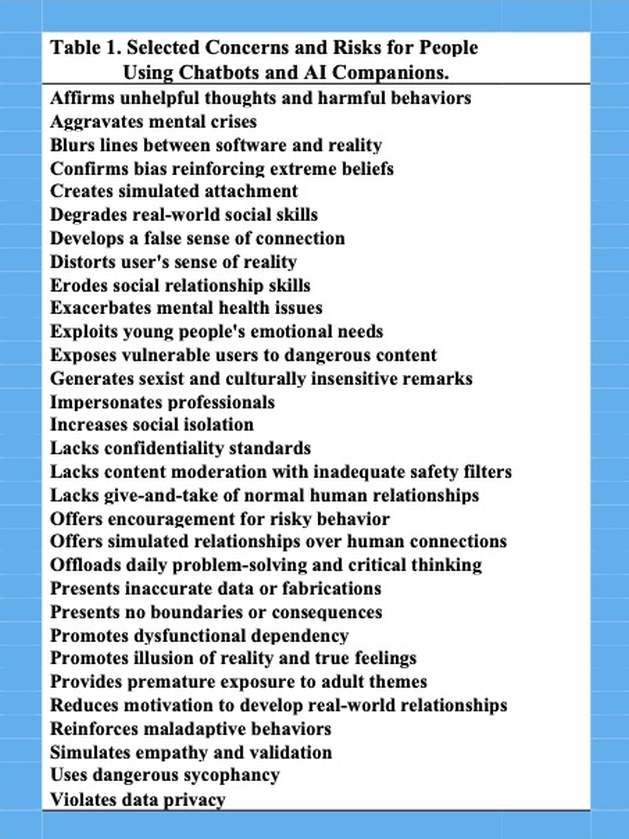
AI chatbots also raise risks to personal privacy, psychological well-being, the spread of misinformation, and the reinforcement of harmful behaviors. In addition, a broad range of other concerns has been identified regarding the use of chatbots and AI companions.
These concerns include delaying social and emotional development among children and teenagers, blurring the distinction between software and reality, encouraging risky behavior, exploiting young people’s emotional needs, reinforcing unhelpful thoughts, distorting users’ sense of reality, and fostering simulated attachments and dependence (Table 1).
Source: Author’s compilation.
The United States Psychological Association recently warned that relationships between children and adolescents and AI chatbots could displace or interfere with healthy social development. The association noted that friendships and social support from other people have long-term benefits for emotional well-being, physical health, and longevity.
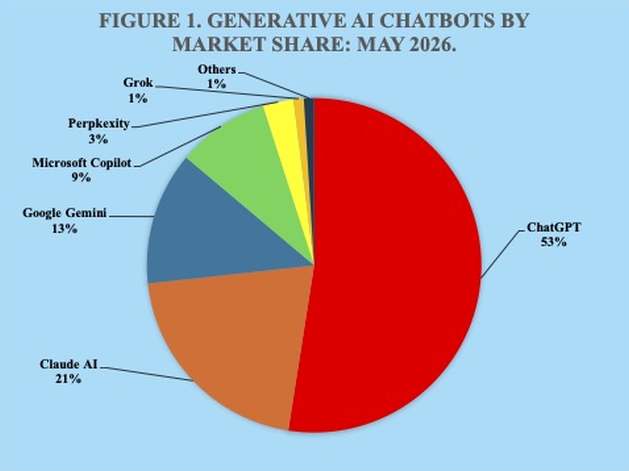
Among generative AI chatbots, the leading platforms by market share in May 2026 are generally reported to be ChatGPT, Claude AI, Google Gemini, Microsoft Copilot, Perplexity, and Grok. Several industry analyses place ChatGPT’s share at roughly 50-55%, with Claude AI at about 21% of market share emerging as the second-largest platform (Figure 1).
Source: FirstPageSage.
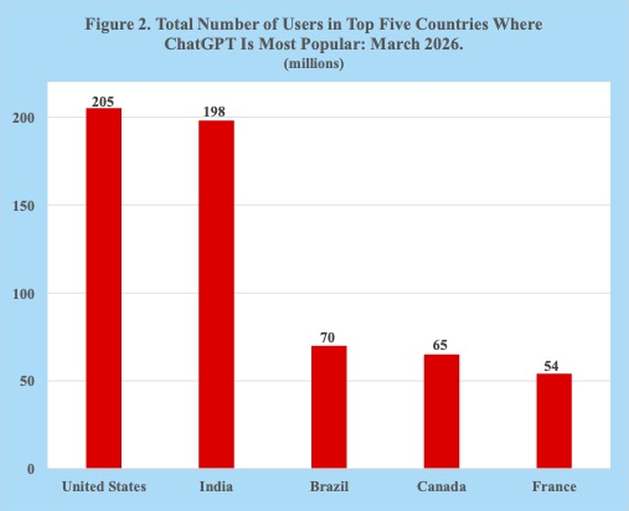
In March 2026, the country with the largest number of ChatGPT users was the United States, with approximately 205 million users. Following the U.S., the countries with the largest ChatGPT user populations were India, Brazil, Canada, and France (Figure 2).
Source: fatjoe.
It is certainly the case that chatbots and AI companions cannot feel love toward an individual. Nevertheless, hundreds of millions of men, women, and children worldwide are increasingly relying on these technologies for conversation, information, companionship, and non-judgmental interactions.
These technologies may help to address chronic loneliness and social isolation, conditions that have consistently been linked to detrimental effects on physical and mental health and increased risk of premature death. The World Health Organization (WHO) formally recognizes loneliness as a global public health concern, with roughly one in six people worldwide experiencing problematic levels of loneliness.
Chatbots and AI companions can help alleviate loneliness and social isolation by providing readily available conversation and companionship without judgement and expectations. As chatbots, AI companions, and androids become increasingly sophisticated, growing numbers of people are exploring the new forms of emotional connection and intimacy with these technologies.
At the same time, the growing use of chatbots and AI companions for personal relationships raises important social, psychological, ethical, and policy concerns.
Although chatbots and AI companions may help reduce loneliness and social isolation for some users, they also pose risks, especially for children and young people. Because AI systems do not possess genuine empathy and are not trained or licensed as mental health professionals, excessive reliance on them for emotional support may isolate vulnerable individuals and distort perceptions of human relationships.
Debate continues regarding the appropriate level of regulations for these technologies. Some government officials, technology companies, investors, and researchers argue that these new and emerging AI technologies should remain largely unregulated, with people themselves determining how to adapt to these technologies.
Some of the reasons for keeping the development of AI unregulated include: prevents regulatory paralysis; accelerates technological breakthroughs; encourages venture capital investment; maintains global geopolitical competitiveness; promotes national security; prevents market monopolies; benefits national interests; and leads to better lives for men and women.
Others, however, argue that AI chatbot and AI companion technologies need to be regulated in order to protect the mental health of children and young adults; reduce the negative effects of social media and excessive screen time; mitigate risks, deception, bias, discrimination, and misinformation; promote economic stability and fairness; become a public resource; protect human rights and intellectual property; and ensure data privacy.
Among the proposed safeguards and regulations for chats and AI companions are requirements for non-human disclosure, crisis protocols for self-harm, age verification measures, limits on their use in elementary schools, bans on impersonation, and stronger protections for minors.
Fueled in part by technology companies, governments worldwide are moving rapidly to deploy generative AI systems and chatbots in schools, universities, and other settings.
However, the spread of these new AI technologies may pose risks to the development and well-being of children and teenagers, raising concerns among educators, parents, and policymakers. Interactions with AI chatbots, especially when they are intense and prolonged, may contribute to the onset or worsen delusions or mania. Research is also finding that AI companions provide responses that may worsen mental health issues.
Additionally, a recent study reported that reliance on generative AI chatbots may reduce critical thinking engagement in some contexts. Another study has raised concerns that AI chatbots can exploit teenagers’ emotional vulnerabilities, sometimes leading to inappropriate and harmful interactions.
The United States Federation of Teachers recommends “no screens” for children in second grade or younger, and restricting the use of AI chatbots for students in elementary schools. The organization has expressed concerns that excessive screen use may hinder socialization, independent thinking, and critical-thinking development.
The long-term effects of AI chatbots remain uncertain, with researchers just beginning to investigate them. However, classroom teachers and some city officials report that many students are increasingly relying on chatbots for easy answers rather than developing problem-solving and critical-thinking skills.
The U.S. Federation of Teachers has urged elementary schools to avoid using artificial intelligence tools like AI chatbots with students and called for national privacy and safety standards governing AI use in schools.
Research suggests that chatbots and AI companions may pose several risks, particularly for teenagers. Concerns include emotional dependency, declining mental health, harmful interactions, and revealing sensitive personal information, including mental health issues and sexual orientation.
Reliance on chatbots and AI companions for emotional support may also contribute to social isolation and interfere with the development of normal human relationships. Because these technologies are designed to simulate emotional intimacy, they can blur the line between genuine human connections and artificial interactions.
A risk-assessment study found that inappropriate dialogue could be readily elicited from chatbots on topics such as sex, self-harm, violence, drug use, and racial stereotypes, raising concerns about their influence on vulnerable users, particularly children and adolescents.
In conclusion, chatbots and AI companions have rapidly moved from science fiction into everyday life. They increasingly exhibit human-like characteristics, including natural-sounding human voices, memory of past interactions, continuous processing of personal information, apparent preferences, constant availability, and the ability to provide companionship and guidance on personal and social matters.
Public discussion of generative AI has focused largely on employment and job displacement, while less attention has been given to its social, psychological, and ethical effects. As chatbots and AI companions become more capable and widely used, concerns about their impact on the well-being, development, and relationships of young people are likely to become increasingly important for parents, educators, policymakers, and technology developers.
Joseph Chamie is a consulting demographer, a former director of the United Nations Population Division, and author of many publications on population issues.

No comments yet... Be the first to leave a reply!